AI Video Production for Brands: The Complete Guide
We have shipped hundreds of AI-generated videos for real brands across ecommerce, SaaS, retail, and enterprise. In that time, the production landscape has changed faster than almost any technology we have worked with, and most brands are still figuring out what that means for their strategy. We are not.
Roughly 30% of all digital video ads are now AI-generated, according to the IAB, and that number is trending toward 40% by the end of 2026. Meanwhile, the global AI video market was valued at $3.86 billion in 2024 and is projected to reach $42.29 billion by 2033. This is not a niche experiment. It’s the new center of gravity for brand video.
This guide covers everything a marketing leader needs to know about AI video production: what it is, how to choose the right approach, what it costs, how quality actually works, and when AI is the right call.

Free Download
Every Tool. Every Decision. One Playbook.
- AI vs. traditional decision tree
- AI video briefing template
- Tool recs by use case
- Budget worksheet
- Partner evaluation checklist
Where should we send it?
Every Tool. Every Decision. One Playbook. — lands in your inbox instantly.
What Is AI Video Production? A Practitioner’s Definition
| AI video production uses generative AI tools to create video content, including scripting, asset generation, visual effects, voiceover, and localization, combined with human direction to ensure brand quality. It differs from traditional production by dramatically reducing timelines (from 6-8 weeks to 2 weeks) and production costs by 60%+. |
The phrase “AI video production” gets applied to a lot of different things, so it’s worth drawing clear distinctions between three distinct approaches.
Generative AI video is the practice of creating video assets entirely from text prompts or reference images, with no camera required. Tools like Runway, Google Veo 3, and Kling generate footage, motion, and visual environments from written descriptions. This is what most people mean when they say “AI video.”
AI-assisted editing applies AI tools to human-shot footage. Think automated color grading, AI-powered captioning, rapid reformatting for different aspect ratios, and localization at scale. The source material is still captured on camera; AI handles the post-production heavy lifting.
Hybrid production combines both approaches. A brand might shoot a spokesperson on camera, then use AI to generate a photorealistic background environment, add motion graphics, and produce 30 localized versions from a single master cut. This is often the most practical path for mid-market brand campaigns.
What AI handles vs. what humans must own is the most important distinction in this entire guide. AI is excellent at rendering, editing, versioning, voice synthesis, and generating visual options at scale. What it cannot do is make strategic decisions, enforce brand judgment, or catch outputs that are technically competent but wrong for your brand. At Lemonlight, our hybrid model means human creative directors are involved at every stage, not just at the end as a QA check.
The timeline difference is meaningful in practice. Traditional production typically runs 6-8 weeks from brief to delivery. An AI-assisted workflow compresses that to approximately 2 weeks for comparable work. According to Wistia’s 2025 State of Video Report, AI adoption in video production jumped from 18% to 41% in a single year, the fastest adoption rate of any marketing technology tracked in the report. Brands are not adopting AI video because it is trendy. They are adopting it because the speed and cost advantages are real.
The Lemonlight perspective: AI did not change what makes video work. It changed how fast you can execute it. Great video still requires a clear brief, a compelling script, visual coherence, and brand judgment throughout. The tools have changed; the creative fundamentals have not.
What Are the Best AI Video Tools for Brands in 2026?
| In 2026, the leading AI video tools for brands include Runway (creative motion), HeyGen and Synthesia (avatar/spokesperson), Veo 3 (cinematic generation), Kling (cost-efficient generation), and Adobe Firefly (brand-integrated editing). No single tool does everything well. At Lemonlight, we use a curated stack depending on project type, not a single platform. Also, our proprietary technology platform, Hero, is the foundation of our production infrastructure, working as a co-pilot alongside our production team. Its AI handles data-driven decision-making and process optimization by centralizing brand assets, managing real-time generation and review of production documents, and automating routine tasks that would otherwise slow a team down. |
The tool landscape for AI video is genuinely crowded, and it changes every quarter. What follows is an honest evaluation organized by production stage, not a ranking. The most important thing to understand before reading this section: no single platform wins across every use case. Professional AI video production requires a stack.
Scripting and Writing
ChatGPT, Claude, Jasper, and Copy.ai are the dominant tools for AI-assisted scriptwriting. Each has strengths in different contexts, from long-form narrative to punchy ad copy. Lemonlight’s Hero platform is built specifically for brand video scripting and integrates directly into the production workflow.
Image Generation
Midjourney, DALL-E 3, Stable Diffusion, Adobe Firefly, and Ideogram are the leading options for generating still frames and reference imagery used in storyboarding and as source material for video generation. Adobe Firefly integrates directly with brand asset libraries, which makes it particularly useful for maintaining visual consistency across campaigns.
Storyboarding and Pre-Production
Storyboarder.ai, Boords, Katalist, and LTX Studio all support AI-assisted storyboard generation. Lemonlight’s Hero platform includes storyboard generation as part of the pre-production workflow, making it accessible to teams without dedicated storyboard artists.
Video Generation
This is the fastest-moving category. Runway Gen-3 Alpha leads on creative control and motion quality. Google Veo 3, documented in Google’s 2025 research review, has introduced native audio-visual generation, which is a significant capability milestone. Sora 2 (OpenAI), Kling 2.6, and Luma Ray3 round out the top tier.
Avatar and Spokesperson
HeyGen and Synthesia are the category leaders for avatar and spokesperson video, each with strong platforms for creating AI presenters at scale. D-ID and Tavus offer an Synthesia alternative and an Heygen alternative worth evaluating depending on your use case, customization requirements, and volume.
Voice and Speech
ElevenLabs, Resemble AI, WellSaid Labs, and PlayHT are the primary options for AI voice synthesis. Quality differences between these platforms matter most when the voice is front-and-center, such as in spokesperson or narration-driven content.
Music and Audio Generation
Suno, Udio, AIVA, Mubert, and Beatoven.ai cover the range from AI-generated original compositions to royalty-free background audio. These tools have made licensed background music largely optional for brands that previously relied on stock libraries.
Editing and Post-Production
Descript, CapCut AI, Opus Clip, Adobe Firefly, and Topaz Video AI are the most widely used AI tools in the post-production stage. Opus Clip is particularly effective for repurposing long-form content into platform-native social cuts. Topaz Video AI handles upscaling and quality enhancement for archival or mixed-quality source material.
One caution that applies to every tool in this list: these platforms generate content. They do not generate strategy, brand judgment, or quality control. A tool can produce a technically polished video that is completely wrong for your brand. The expertise that matters most is knowing when to use which tool, what to do with the output, and when to reject it.
Lemonlight is tool-agnostic. We select the right tool for each project based on creative requirements, quality standards, and brand fit. Our only interest is the best outcome for your brand. Brands that want to use the same production workflow our team uses can access it through the Hero platform.
When Should You Use AI Video vs. Traditional vs. Hybrid Production?
| Use AI video when you need speed, scale, or cost efficiency, such as for performance ads, social content, ecommerce visuals, and multi-language versions. Use traditional production for flagship brand films where emotional authenticity is non-negotiable. Use hybrid when you want high-production-value visuals without the full cost or timeline by replacing specific elements like VFX-heavy scenes, complex environments, or hard-to-access locations while maintaining a polished feel. Lemonlight recommends the path that serves your brand best. |
The most useful thing we can do here is give you a real decision framework, not a sales pitch. There are projects where AI video is the obvious right call. There are projects where we recommend traditional production even when a client comes to us asking for AI. That honesty is what being tool-agnostic actually looks like in practice.
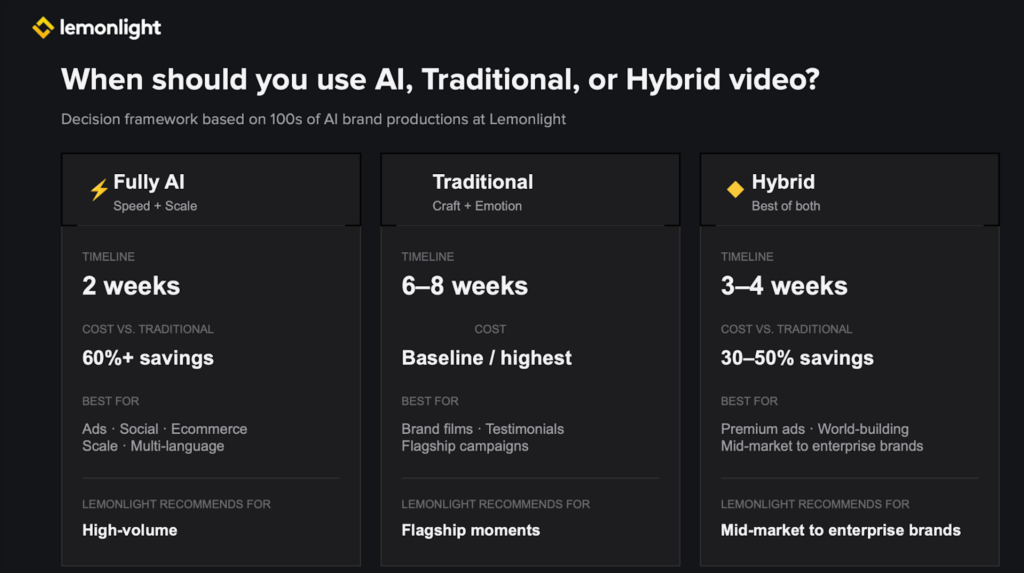
When AI video is clearly the right call: performance video ads where you need 20+ format variants from a single concept, ecommerce lifestyle content that needs to be refreshed seasonally, multi-language localization of existing campaigns, and social content programs that require consistent weekly or daily output.
When traditional production is clearly the right call: flagship brand films built around authentic human performance, customer testimonials that depend on genuine emotion, live-event coverage, and any project where the brief explicitly centers on human presence that cannot be synthesized.
When hybrid is the right call: campaigns where you have a strong live-action core but want to extend it with AI-generated environments, variations, or effects without reshooting. Think of a scenario where you take a traditionally produced campaign and use AI to generate multiple location backgrounds, produce a localized version with a different spokesperson, or create a CTV cut from a longer social piece.
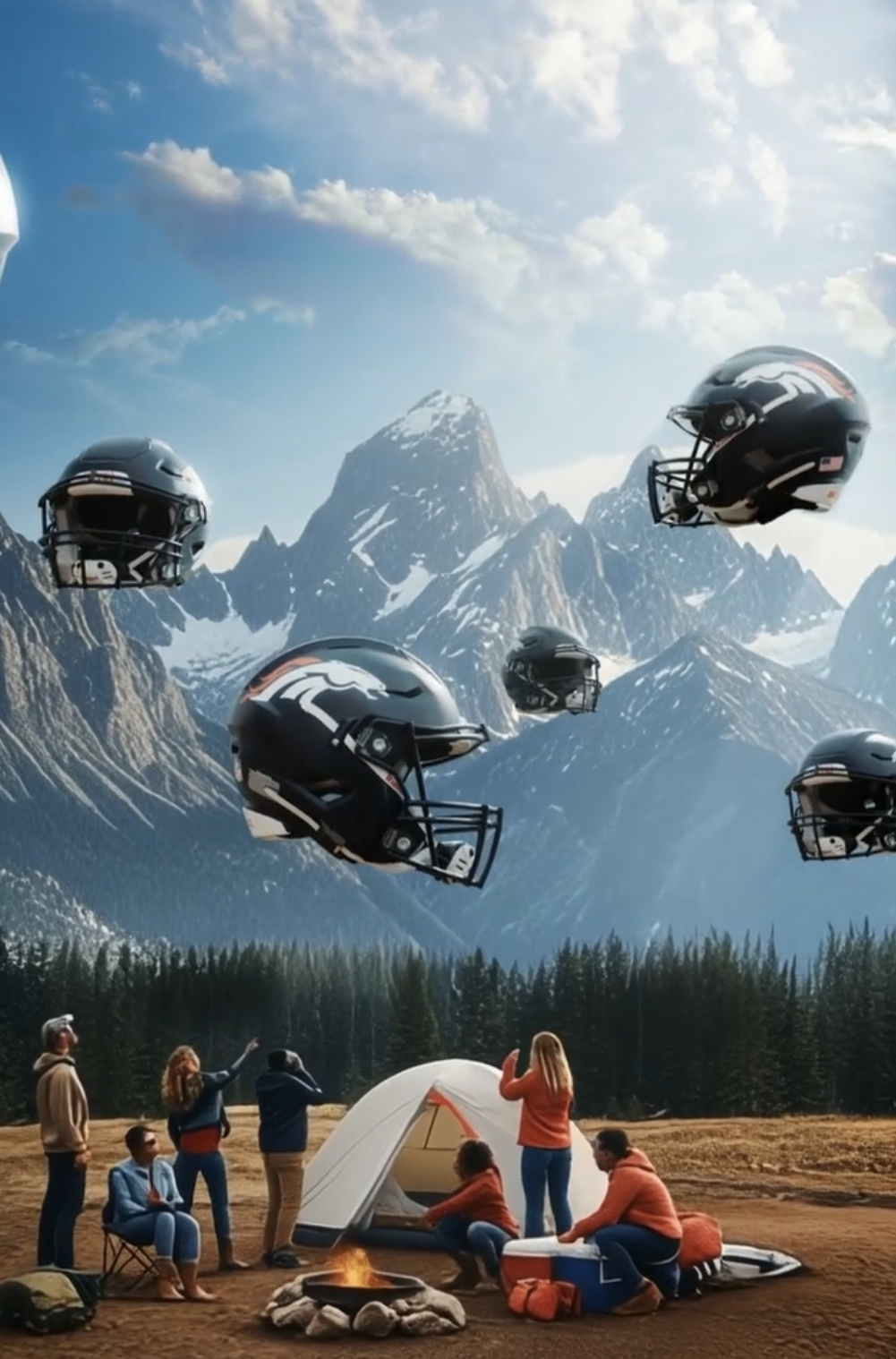
Our recent project for Poshmark is a great example of this hybrid approach, as it’s a full-scale production with AI elements layered in after the fact. The magazine coming to life adds character to the video and makes it more of an eye-catching, effective social video ad.
However, We’ve had clients come to us asking for AI video who ended up better served by a doc-style shoot. We told them that. That is what being tool-agnostic looks like in practice.
For brands that want to run the workflow themselves, Hero provides access to the same production process our team uses, available as a self-serve option.
How Does AI Video Production Actually Work? Lemonlight’s Workflow Explained
| Lemonlight’s AI video production workflow runs in four phases: Strategy (defining goals, audience, and creative direction with a dedicated producer), Script and Storyboard (professional writers and AI-assisted visual planning), AI Generation and Human Editing (AI asset creation followed by human creative review and brand alignment), and Delivery (quality-checked content in approximately 2 weeks, in all required formats). |
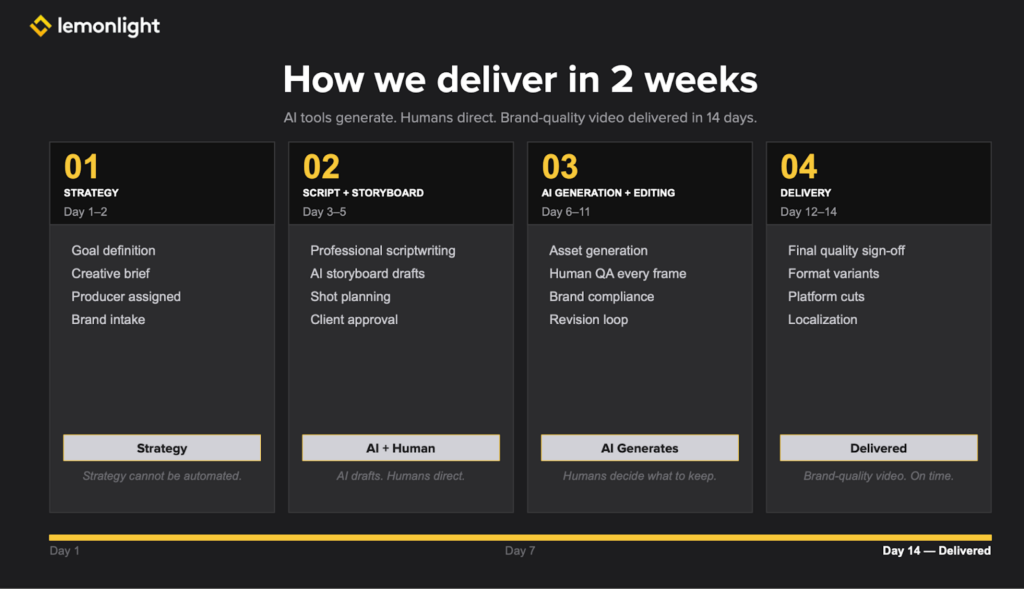
Understanding the workflow is what separates brands that get consistently good results from AI video from those that get inconsistent ones. The tools matter less than the process around them.
Phase 1: Strategy
Every project starts with goal definition: what the video needs to accomplish, who it’s for, what response it should trigger, and how it will be distributed. A dedicated producer is assigned to own the project from kickoff through delivery. This person is the single point of accountability for creative direction, timeline, and brand alignment throughout. The strategy phase is where most DIY AI video goes wrong. Without a clear brief, AI generation defaults to generic.
Phase 2: Script and Storyboard
Professional scriptwriters develop the narrative. This is human work. AI tools can assist with first drafts or structural options, but the final script that goes into production is written and approved by experienced writers with brand knowledge. Storyboarding follows, often using AI-assisted tools to generate first-frame references and shot planning. This visual blueprint is what the generation phase works from.
Phase 3: AI Generation and Human Editing
This is the phase most people think of when they imagine AI video production. AI tools generate visual assets, motion sequences, voiceover, and other elements based on the approved script and storyboard. The specific tools used depend on the project: Veo 3 for cinematic environments, HeyGen for spokesperson content, ElevenLabs for voice, Adobe Firefly for brand-color corrections and post work.
What happens after generation is equally important. Human editors and creative producers review every AI-generated asset against the brand brief and style guide. Assets that are technically competent but tonally wrong are rejected. Brand color, typography, and pacing are verified by humans, not algorithms. This revision loop is where the quality difference between professional AI video and DIY AI video becomes visible.
Phase 4: Delivery and Versioning
Final QA passes check for visual artifacts, audio sync issues, brand compliance, and format accuracy. Deliverables are produced in all required formats: 16:9, 9:16, square, and any platform-specific dimensions, along with duration cuts (15-second, 30-second, 60-second) as specified in the brief. Localization into additional languages, if required, happens at this stage before final sign-off.
The full process runs approximately 2 weeks end-to-end. Lemonlight’s network of 2,000 AI-trained editors worldwide is the infrastructure that makes this timeline consistent at any volume. That network is not a selling point for volume alone; it is the reason quality does not degrade when a campaign requires 50 variants instead of 5.
A summary of how responsibility is divided: AI handles rendering, editing automation, versioning, voice synthesis, and generating visual options. Humans own strategy, creative direction, taste, quality judgment, and brand compliance. That division is not a compromise. It’s what makes the output usable.
How Do You Ensure Quality in AI Video Production for Brands?
| At Lemonlight, quality control in AI video production means every AI-generated asset passes through a human creative before delivery. We do not ship AI videos that look like AI videos. Our standard is brand-appropriate quality regardless of production method. That means human taste, human judgment, and human accountability on every frame. |
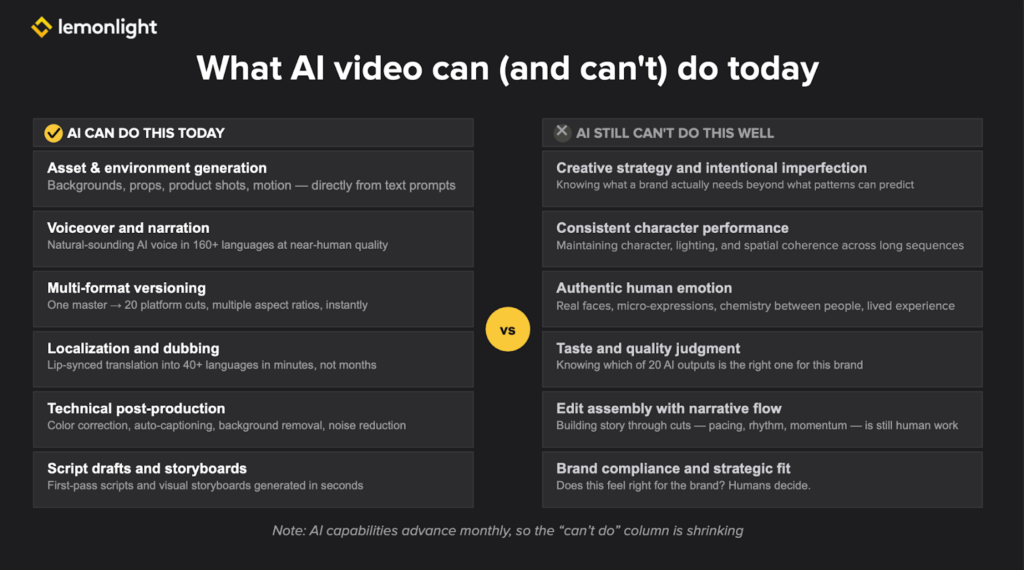
The most common objection to AI video from experienced marketers is quality: the fear that AI-generated content looks cheap, generic, or off-brand. That fear is legitimate when applied to DIY AI video without professional oversight. It’s less applicable when a production company with mature quality-control processes is involved.
Here’s what the quality failure modes actually look like in AI-generated video, so you know what to watch for. Temporal inconsistency occurs when a character’s appearance, clothing, or environment changes subtly between frames in ways that look unnatural in motion. Character drift is the progressive degradation of a generated character’s visual identity across a longer clip. Artifact retention refers to digital artifacts, smearing, or visual noise that AI models sometimes produce at frame edges or during motion. All three of these failure modes are detectable by trained human reviewers and invisible to automated QA.
Lemonlight’s quality gates are structured around three checkpoints. First, a producer review against the creative brief, checking for goal alignment, pacing, and narrative coherence. Second, a brand guideline check covering color accuracy, typography, logo usage, and tone. Third, a human creative sign-off that addresses the harder-to-quantify question: does this feel right for the brand? We do not ship videos that clear the first two gates but fail the third.
An IAB consumer sentiment study found that while 82% of ad executives believe consumers feel positive about AI ads, only 45% of consumers actually do. Gen Z negativity toward AI ads has grown 12 points since 2024. That gap exists largely because the volume of low-quality, obviously AI-generated content has grown alongside the adoption curve. The brands that close that gap are the ones investing in human quality control, not just AI generation.
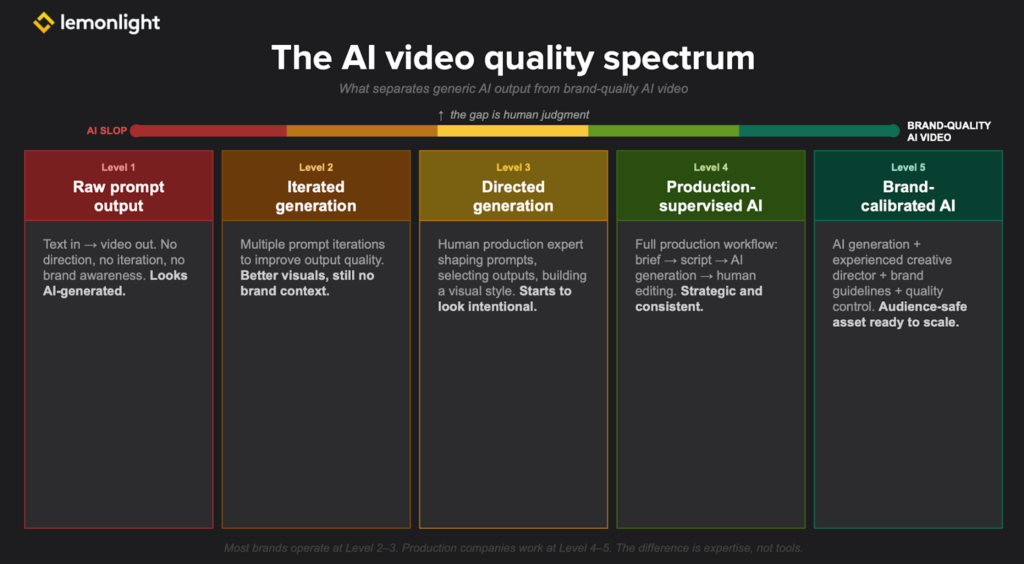
Lemonlight’s 4.8/5 quality score from brand clients reflects this approach. AI generates options. Humans decide which one is right. That principle applies to every frame of every video we produce.
The most credibility-building thing we can tell a prospective client is not a feature list. It is this: we reject AI outputs regularly. When an asset looks like it was made by AI, we do not ship it. We generate again, or we solve the problem differently. That is the standard.
What Does AI Video Production Cost? A Complete Pricing Guide
| AI video production costs vary by project scope, complexity, and whether you use DIY tools, freelancers, or a full-service agency. At Lemonlight, AI video production starts at $5,000 for a professional 30-second brand video, approximately 60% less than traditional production at equivalent quality. Enterprise pricing for high-volume campaigns is available on request. |
| Tier | Description | Typical Cost Range | Best For |
| DIY AI Tools | Platforms like Synthesia, HeyGen, Canva AI | $20-$300/month subscription | Simple content, internal use, training videos |
| Freelance / Project | Freelancer using AI tools on your project | $500-$5,000/project | One-off needs, budget-constrained campaigns |
| AI Video Production (Lemonlight) | Strategy + scripting + AI production + human QA | Starting at $5,000/video | Brand campaigns, performance ads, enterprise volume |
| Traditional Production (benchmark) | Full crew, location, post-production | $15,000-$50,000+/video | Flagship brand films, high-emotional-stakes content |
The Hidden Costs of DIY AI Video Production
The cost tiers above tell most of the story, but they understate one important dynamic: DIY AI video is rarely as cheap as the subscription price implies.
A professional AI video production workflow requires multiple software subscriptions running simultaneously: a video generation platform, a voice synthesis tool, an editing application, a music licensing or generation service, and often a separate image generation tool for pre-production assets. Subscription costs alone can reach $300-600 per month before a single frame is generated.
Beyond subscriptions, there are compute costs for rendering and iteration. AI video generation is not a one-shot process. A single 30-second video may require 15-30 generation attempts to produce 3-4 usable candidates, each consuming compute credits. Then there is the human element: creative direction, prompt engineering, scripting, editing, and quality control all require skilled time. If your team does not have those skills in-house, you are adding contractor costs or significant internal bandwidth that is not captured in the tool price.
The key point: DIY AI video is not a tool cost. It is an ecosystem cost. Without the right expertise and workflow already dialed in, brands often spend more time and money chasing quality than they would have by working with a production company that already has the infrastructure in place.
What drives professional production costs up: script complexity, the number of characters and locations, revision rounds, localization into additional languages, and the requirement for custom brand assets that cannot be pulled from stock libraries.
The right framing for ROI is not whether AI video costs less. It does, significantly. The question is whether those savings go toward cheaper outcomes or toward more outcomes. Brands that redirect the 60%+ savings from AI production into more variants, more testing, and broader reach are the ones seeing the strongest returns.
Scope Your AI Video Projects with Lemonlight.
Most clients know within 15 minutes whether AI is the right approach for their project. We’ll tell you honestly either way.
Free Download
One Download. Five Tools.
Zero Guesswork.
For marketing leaders ready to stop experimenting and start executing on AI video.
Where should
we send it?
Lands in your inbox instantly.
What Types of Videos Can Brands Actually Make with AI?
| Brands using AI video production at Lemonlight most frequently produce: performance video ads (social, CTV, pre-roll), AI spokesperson and avatar videos, product demo and explainer videos, ecommerce lifestyle content, multi-market localized versions of existing campaigns, and social media content at scale. Not everything should be AI. See the decision framework above for guidance on when traditional or hybrid is the better call. |
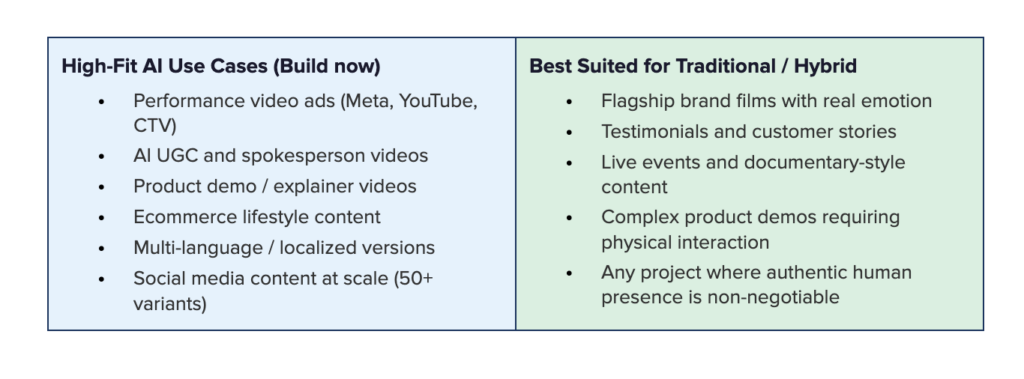
The use cases where AI video production delivers the clearest returns share a common characteristic: volume and variation matter as much as the individual piece. Here is how we categorize them.
Performance Video Ads (Meta, YouTube, CTV)
This is the highest-volume use case for AI video at Lemonlight. Performance advertising requires constant creative refresh, multiple format variants, and rapid iteration based on real-time data. AI production makes it practical to test 20 creative variants where traditional production would allow 2 or 3. E-commerce brands using AI video have seen significant increases in product listing engagement, according to industry data, precisely because they can test and iterate faster.
AI UGC and Spokesperson Videos
AI-generated user-generated content (UGC) and spokesperson videos have become one of the most requested formats at Lemonlight. These videos replicate the native, lo-fi aesthetic of creator content while maintaining brand messaging control. HeyGen and Synthesia are the primary tools for avatar-based spokesperson content, with D-ID and Tavus offering alternatives for specific use cases.
Product Demo and Explainer Videos
For SaaS, technology, and consumer products, AI-generated demo and explainer videos reduce the production overhead of keeping product videos current as features change. A traditionally produced product demo can be outdated within a product cycle. An AI-assisted workflow allows for faster updates without reshooting.
E-commerce Lifestyle Content
AI-generated lifestyle imagery and video has become a significant part of e-commerce production, particularly for brands managing large SKU catalogs. Rather than organizing individual product shoots, brands can generate photorealistic lifestyle contexts for multiple products using a consistent visual style.
Multi-Language and Localized Versions
Localization is one of the clearest-cut cost wins for AI video. Producing 10 language versions of a 60-second brand video traditionally requires 10 separate voice recordings, 10 editorial passes for lip-sync or subtitles, and 10 delivery packages. AI-assisted localization handles voice synthesis, subtitle generation, and format adaptation in a fraction of the time and cost.
Social Media Content at Scale
Brand social programs that require consistent, frequent output (weekly or daily content across multiple platforms) are well-suited to AI-assisted production. A single concept can be extended into 50+ variants in different formats, with different hooks, calls to action, or visual treatments.
For context on where the lines are: flagship brand films, authentic customer testimonials, live-event coverage, complex product demos requiring physical interaction, and any content where genuine human presence is the point are still better served by traditional or hybrid production.
Where Is AI Video Production Headed? What Brands Need to Know for 2026 and Beyond
| In 2026, AI video production is moving toward full scene generation from text prompts, native audio integration (Veo 3), and real-time multi-language localization. The technology is evolving monthly. What is not changing: the brands that win with AI video are the ones pairing the best tools with the best creative judgment, not just clicking generate. |

According to the IAB, 90% of advertisers will integrate AI into video ad production by end of 2026. That projection, combined with the 5x surge in monthly AI video orders documented between December 2025 and January 2026, points to an adoption curve that has already crossed the inflection point.
Near-Term (2026): What Is Working Now
The models to watch in 2026 are Veo 3.2 (Google’s latest iteration, with native audio-visual generation documented in Google Research’s 2025 annual review), Sora 2 (OpenAI’s second-generation video model), and Kling 2.6 (strong on cost efficiency at scale). Native audio integration is the most significant 2026 capability development. Previously, audio had to be added in post-production as a separate step; Veo 3’s ability to generate synchronized audio alongside video substantially reduces that overhead.
Longer clip durations are also improving meaningfully. Early AI video tools were limited to 4-second or 8-second clips, making them useful for motion graphics but impractical for narrative content. Current generation tools handle 30-60 seconds reliably, which makes longer-form brand content feasible for the first time.
Medium-Term (2027-2028): Where the Technology Is Going
Real-time generation and hyper-personalization at scale are the two capabilities that will define the medium-term. Real-time generation, where video is rendered on-demand rather than pre-produced, opens the door to dynamically personalized video content served at the individual viewer level. Agent-directed production, where AI models handle multi-step production tasks autonomously based on a high-level brief, is already in early-stage development.
The practical implication for brands: the production infrastructure you build now, including the internal expertise, the agency relationships, and the quality standards, will need to accommodate tools that do not exist yet. Betting on any single model or platform is a mistake.
What Will Not Change
Creative judgment, brand strategy, and production expertise are not going to be automated away. They are going to move upstream. The brands that win with AI video in 2027 and 2028 will not be the ones with the best tools. They will be the ones with the clearest creative vision and the most disciplined quality standards.
Lemonlight’s position is simple: we are not betting on any single model. We are building the operational expertise to use whatever tools emerge. Our tool stack has evolved significantly over the past year, with specific models adopted and specific workflows replaced as better options became available. That adaptability is the only durable competitive advantage in a category that changes this fast.
There is also a quality correction coming. A 2026 industry analysis noted that more than 20% of YouTube content for new users has been classified as low-quality AI-generated video, with enormous aggregate viewership. As that volume grows, consumer tolerance for obviously AI-generated content will decline. The brands that invest in quality now will be better positioned when the market shifts against generic AI output.
Why Do Brands Choose Lemonlight for AI Video Production?
| Lemonlight is the AI video production company for brands that need professional quality, not just fast output. We have produced 40,000+ videos for 4,500+ brands, including Amazon, Rolex, and Revlon, and have built AI workflows that deliver brand-quality video in 2 weeks at 60%+ cost savings. Our 2,000-strong network of AI-trained editors is the largest in the industry. |
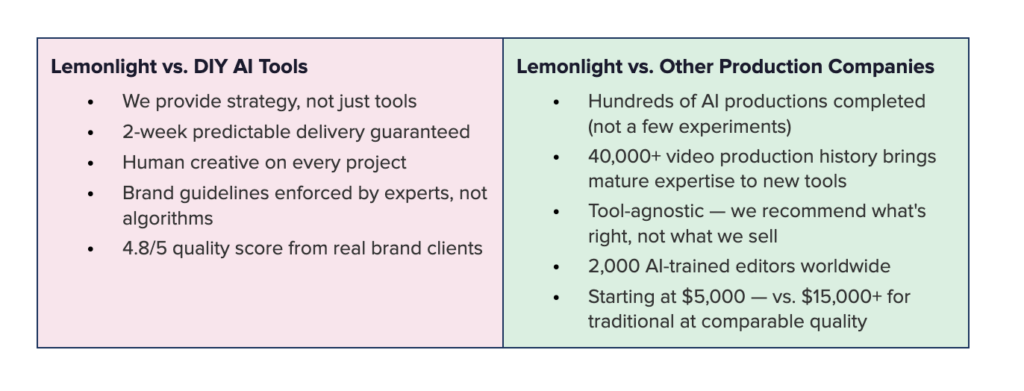
Lemonlight vs. DIY AI Tools
DIY AI tools give you access to the generation capability. They do not give you strategy, creative direction, or quality control. The 2-week delivery timeline Lemonlight commits to is not just about the tools; it’s about having a dedicated producer, a structured workflow, and 2,000 trained editors available to execute against a clear brief. Brand guidelines are enforced by human experts, not by the algorithm’s best interpretation of a style prompt. Our 4.8/5 quality score from brand clients reflects what that human oversight actually produces.
Lemonlight vs. Other Production Companies
Hundreds of AI productions completed for paying brand clients is a different credential from a few experiments or a white paper. Lemonlight’s 40,000-video production history means our team brings the same mature editorial judgment to new AI tools that we applied to traditional production. We are also tool-agnostic in a way that vendor-aligned production companies cannot be: we recommend what is right for your project, not what the platform we resell wants us to sell. Our network of 2,000 AI-trained editors worldwide means we can scale to enterprise volume without the quality degradation that comes from staffing up reactively.
Starting at $5,000 per video for professional AI production, compared to $15,000 to $50,000 for traditional production at equivalent quality, the cost case is straightforward. The more important conversation is what those savings enable: more creative testing, more format variants, more reach, and more iterations informed by real performance data.
Brands including Amazon, Walmart, Rolex, BIC, Vicks, and Dyson have trusted Lemonlight with their video production. Those relationships are not built on tools. They are built on consistent, predictable delivery of brand-quality content, and on a team that tells clients when AI is not the right call for their project.
For brands that are not ready for full-service production, Hero provides access to the same production workflow our team uses, available as a self-serve option.
Ready to see what AI video production can do for your brand? Most clients know within 15 minutes whether AI is right for their project. Book a no-pressure strategy call and we’ll tell you honestly.
Frequently Asked Questions
What is AI video production for brands?
AI video production for brands uses generative AI tools — for scripting, visual generation, voiceover, and editing — combined with human creative direction to produce brand-quality video faster and at lower cost. At Lemonlight, our AI video workflow delivers finished brand videos in 2 weeks with 60%+ cost savings versus traditional production.
How much does AI video production cost for brands?
AI video production costs range from $20–$300/month for DIY tools to $5,000+ for full-service agency production. Lemonlight’s AI video production starts at $5,000 for a professional 30-second brand video — approximately 60% less than traditional production at equivalent quality. Enterprise volume pricing is available for campaigns requiring 10+ videos.
What types of videos can AI produce for brands?
AI video production works well for performance ads (Meta, YouTube, CTV), AI spokesperson and avatar videos, product demos and explainers, e-commerce lifestyle content, and multi-language localized campaigns. It’s best for high-volume, format-flexible content. Traditional production is still recommended for flagship brand films and authentic testimonials.
How long does AI video production take?
With Lemonlight’s AI-assisted workflow, end-to-end production — from strategy through delivery — takes approximately 2 weeks. This includes scripting, AI asset generation, human editing, brand compliance review, and final quality assurance. Traditional production typically takes 6–8 weeks for comparable work.
Is AI video production quality good enough for brand marketing?
Yes, when guided by experienced human producers. AI tools alone default to generic outputs. At Lemonlight, every AI-generated asset is reviewed by a human creative who enforces brand standards, tone, and visual consistency. Our 4.8/5 quality score from brand clients reflects this hybrid approach — AI efficiency with human accountability.
What is the difference between AI video production and traditional video production?
Traditional video production involves camera crews, physical locations, and weeks of editing — delivering the highest creative control but at significant cost and time. AI video production uses generative tools to create assets digitally, reducing timelines from 6–8 weeks to 2 weeks and costs by 60%+. Hybrid approaches combine both for specific project types.
What AI video tools do professional agencies use?
Leading agencies use a curated stack rather than a single tool. Lemonlight uses tools including Runway, Veo 3, HeyGen, and Adobe Firefly, selected based on project requirements. For generation, Veo 3 and Kling lead on quality. For spokesperson/avatar content, HeyGen and Synthesia are most reliable. Adobe Firefly integrates well with brand asset management.
When should a brand use AI video instead of traditional production?
Use AI video when you need speed (2-week delivery), scale (50+ videos per campaign), cost efficiency (60%+ savings), or multiple format variants from a single concept. Use traditional production for brand films requiring authentic human performance, complex live-action sequences, or high-stakes flagship campaigns where emotional depth is the primary goal.
How does Lemonlight ensure brand consistency in AI video production?
Lemonlight assigns a human producer and creative to every project who deeply understand your brand guidelines, visual identity, and target audience. AI handles generation and technical execution; humans make every creative decision. Our 2,000-strong AI-trained editor network and internal brand compliance checks ensure consistent output at any volume.
What is generative AI video production and how is it different from AI-assisted editing?
Generative AI video production creates video assets entirely from text prompts or reference images — no camera required. AI-assisted editing applies AI tools to human-shot footage for automated color grading, captioning, versioning, and localization. Hybrid production combines both. Lemonlight uses all three approaches depending on project requirements.